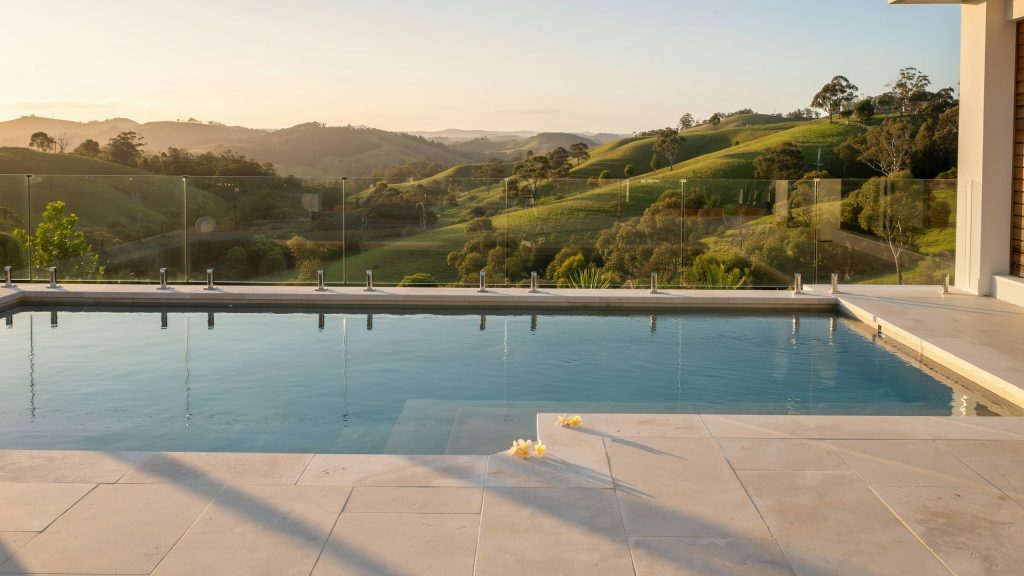
Frameless glass pool fencing is the modern standard for pool safety in Byron Bay: panels of 12mm toughened glass, held by stainless steel spigots, with no posts or rails in sight. It keeps kids safely on the right side of the water without blocking the view you bought the place for.
Installed across the Byron Shire, a compliant frameless fence typically costs $320–$600 per lineal metre and must meet Australian Standard AS1926.1 under the NSW Swimming Pools Act.
This guide walks you through every decision that matters: glass, mounting systems, hardware, compliance, cost and process, so you can plan with confidence.
What Is Frameless Glass Pool Fencing?
A frameless glass pool fence is a safety barrier made from individual panels of toughened safety glass. Each panel stands on its own spigots, small stainless steel clamps anchored into your slab, coping or deck.
No posts. No frames. Just glass and daylight.
Here’s how it compares to the other options:
| System | Sightlines | Look | Typical installed cost |
|---|---|---|---|
| Frameless glass | Uninterrupted | Premium, architectural | $320 – $600 /m |
| Semi-frameless glass | Good, posts between panels | Clean but visible | $250 – $350 /m |
| Aluminium/tubular | Vertical bars throughout | Practical | $90 – $150 /m |
Frameless costs more because the glass is thicker and the installation more precise. What you get back is an unobstructed view of the pool from anywhere in the yard, which, beyond looking spectacular, makes supervising swimming kids genuinely easier.
Around the Northern Rivers, that trade-off usually decides itself. When your backdrop is the paddocks behind Bangalow or the break at Broken Head, nobody wants to look at it through bars.
The Two Big Decisions: Glass and Mounting
Every frameless fence comes down to two choices. Get these right and the rest falls into place.
Decision 1: Standard Clear or Ultra-Clear Low-Iron Glass?
Standard toughened glass has a faint green tint, a natural result of iron in the glass. Once the fence is installed and full of garden reflections, most people never notice it.
Low-iron (ultra-clear) glass removes that tint completely, for roughly 15–20% more.
When is it worth it? Two situations:
- The fence sits in front of a view you paid a premium for: ocean, valley, that one perfect poinciana.
- The glass sits against white walls or pale stone, where the green edge can stand out as a colour clash.
For a standard surround with plenty of planting, standard clear glass is usually the smarter spend. Either way, every panel must be Grade A toughened glass certified to AS/NZS 2208. That part is non-negotiable.
Decision 2: Spigots or a Recessed Channel?
Your fence is only as good as what’s holding it up. There are three mounting options, and your site usually picks for you:
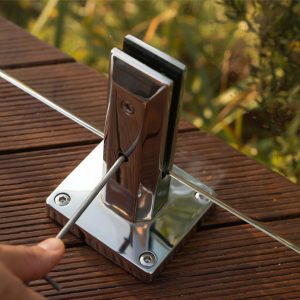
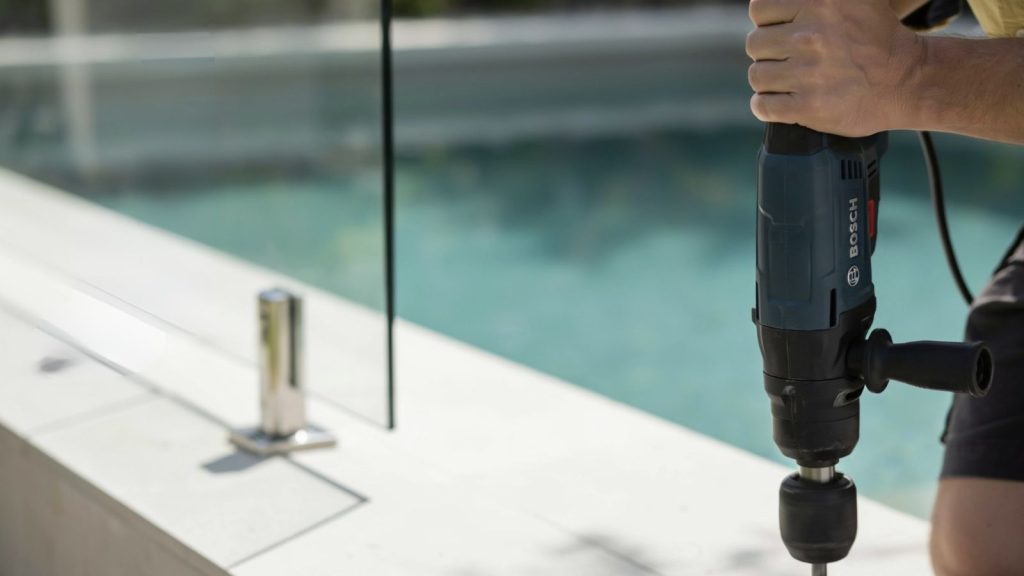
- Core-drilled spigots: set into holes drilled in structural concrete and grouted solid. The regional workhorse: strongest, most rigid, best value. If you have a sound concrete surround, this is almost always the answer.
- Base-plated spigots: bolted to the surface instead of into it. The right call for timber decks (common on hinterland pole homes) or slabs that can’t be core-drilled.
- Recessed channel: the glass drops into a continuous channel in the slab. No spigots at all, completely flush, the most architectural finish. It costs the most and needs to be planned before the slab is poured.
Quick rule of thumb:
Existing concrete → core-drilled.
Timber deck → base-plated.
New architectural build → consider channel.
We cover the full comparison in our dedicated spigot vs channel guide, but for most Byron homes, core-drilled spigots deliver the best mix of strength, looks and cost.
Built for Salt Air: Glass Thickness and Hardware
Living near the coast is the dream. It’s also brutal on metal. Two specifications protect your investment here.
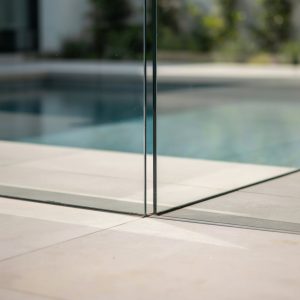
12mm toughened glass. With no posts sharing the load, each panel must stand up to wind and impact on its own. That’s why frameless systems use 12mm glass rather than the 8-10mm found in semi-frameless fences. Spigot positions are set to a structural formula under AS1926.1 , a minimum of two spigots per panel, spaced to handle local wind loads. Your installer handles the maths; your job is simply to confirm they’re doing it.
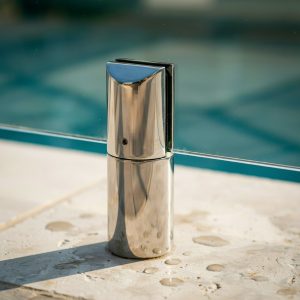
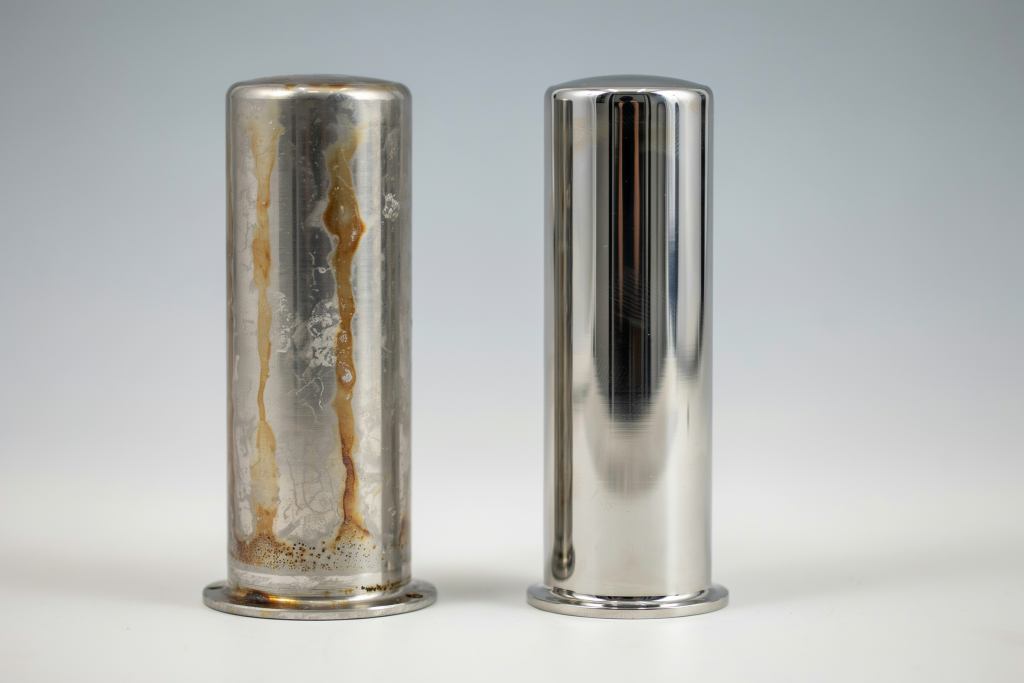
Duplex 2205 stainless steel hardware. Most fencing nationally uses 316 “marine-grade” stainless. Close to the surf, 316 still stains and pits over time. Duplex 2205 is a step above — ASSDA rates it for superior corrosion resistance (a PREN of 34+) and roughly double the strength of 316, with far better resistance to the tea staining and cracking that salt spray causes.
In plain terms: from Wategos to Lennox Head, 2205 spigots still look sharp in year twelve. Lesser grades can look like a shipwreck by year four.
The Safety Rules, In Plain English
NSW pool fencing law sounds intimidating. It isn’t. As explained by Swimming Pool and Spa Association Australia, (SPASA), AS1926.1 boils down to four things:
- Height: at least 1200mm from the ground, measured on the outside.
- Gaps: nothing bigger than 100mm, under the glass, between panels, anywhere.
- Non-climbable zone: 900mm outside the fence must be clear of anything a child could climb. Pot plants, furniture, that enthusiastic banksia, all get moved back.
- The gate: must open away from the pool, close itself from any position, and latch itself, with the release at least 1500mm high. A magnetic latch like the D&D MagnaLatch is the benchmark, and a hydraulic soft-close hinge is the premium upgrade. It closes reliably without slamming.
A well-designed frameless fence meets every clause while looking like it was always part of the architecture. Safety and beauty aren’t competing here.
Getting Certified in Byron Shire
Here’s the part most guides gloss over: the paperwork. Under the Byron Shire Council Swimming Pool Safety Barrier Program, certification follows a simple path:
- Register your pool on the NSW Swimming Pool Register (or check your existing certificate hasn’t expired).
- Book an inspection. Mandatory if you’re selling or leasing, and triggered otherwise by expired certificates, complaints, or council programs.
- Apply through the Council’s Swimming Pool Certificate portal, or use an accredited private certifier.
- Receive your result: a Certificate of Compliance (valid three years) or a Certificate of Non-Compliance listing what to fix and by when.
When your fence is installed properly in the first place, this is a formality. We build to the certifier’s checklist, so inspection day is a walk-through, not a nail-biter.
What It Costs in 2026
The table below reflects real-world 2026 regional rates, including materials, marine-grade hardware, professional installation labour and GST.
Comprehensive Price Guide & Component Matrix (2026)
| System Component / Option | Supply Only (Est.) | Installed Price (per L/M or unit) | Best Fit |
|---|---|---|---|
| Standard Frameless (12mm) | $180 – $250 /m | $320 – $450 /m | Concrete surrounds, tiled patios, reinforced decks. Standard clear toughened glass. |
| Premium Frameless (Low-Iron) | $240 – $320 /m | $450 – $600 /m | Architectural homes wanting zero green tint. Maximises valley, beach or garden views. |
| Recessed Channel System | $290 – $380 /m | $550 – $750+ /m | Pre-planned builds with a channel cast or cut into the slab. Totally flush finish. |
| Core Drilled Spigots (Duplex 2205) | $70 – $100 each | Included in metre rate | Structural concrete slabs and pool copings. Highly rigid. |
| Base Plated Spigots (Duplex 2205) | $65 – $95 each | Included in metre rate | Timber decks, or where core drilling isn’t possible. |
| Insulated Spigots (No Earthing) | $80 – $120 each | +$40 – $70 /m | Required within 1.25m of the pool edge. Avoids costly earthing lines. |
| Standard Spring-Loaded Gate | $300 – $450 /unit | $550 – $800 per gate | Entry-level. Needs periodic tension adjustment. |
| Premium Hydraulic Soft-Close Gate | $650 – $850 /unit | $950 – $1,400+ per gate | Heavy-duty grade. No slamming, no glass rattle. |
| EnduroShield Factory Coating | $35 – $50 /m | +$60 – $90 /m | Strongly recommended in coastal pockets (e.g. Lennox Head) against salt spray and scaling. |
To make that concrete: a typical 14-metre fence in standard 12mm glass with one hydraulic gate lands somewhere between $5,400 and $7,700 installed. Slope, access and custom panels move the number. An on-site measure pins it down exactly.
One tip worth its weight: within a couple of kilometres of the beach, the EnduroShield coating is close to essential. It stops salt bonding to the glass, turning maintenance from scrubbing into hosing.
How Installation Works
From first call to certificate, here’s the journey:
- Site measure and design. We assess your slab or deck, map the panel layout and talk through glass and gate options.
- Compliance check. The design is confirmed against AS1926.1 before anything is ordered.
- Fabrication. Panels are cut and toughened to AS/NZS 2208. Allow two to three weeks.
- Installation. Spigots set plumb and level, glass hung, gaps checked to the mm, gate tuned to close itself from a whisper. Usually one to three days on site.
- Certification handover. You get a fence ready to pass inspection first time.
Timing tip: book after your coping and tiling are done, but before landscaping handover. Your landscaper will thank you. And so will your non-climbable zone.
The Frameless Look: Design Inspiration
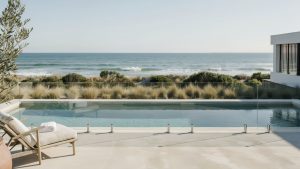
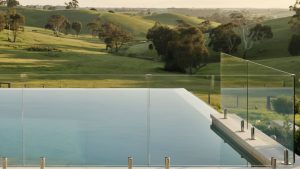
Every yard in the Northern Rivers is different. Sloping decks in the hinterland, salt-blasted frontages at Belongil, tight courtyard pools in town. The gallery above shows how frameless glass adapts to each without compromising compliance or the view.
Frequently Asked Questions
How much does frameless glass pool fencing cost per metre? In the Byron region in 2026: $320-$450/m installed for standard 12mm frameless, $450-$600/m for low-iron glass, and $550-$750+/m for recessed channel systems, including GST.
Is 12mm glass necessary near the coast? Yes. Frameless panels have no posts, so the glass carries all wind and impact loads itself. 12mm toughened is the structural standard for frameless systems.
Do the spigots rust near the beach? Quality ones don’t. Duplex 2205 stainless steel resists the pitting and tea staining that salt air inflicts on lesser grades, which is why it’s all we install.
Does frameless fencing meet NSW pool safety rules? A properly installed system fully complies with AS1926.1: 1200mm height, gaps under 100mm, a 900mm non-climbable zone, and a self-closing, self-latching gate.
Can it be installed on a timber deck or pavers? Yes. Base-plated spigots suit structural timber decks; core-drilled spigots suit concrete and coping. Pavers are usually drilled through to the slab beneath.
How long does it take? Two to three weeks for fabrication after measure, then one to three days on site.
Do I need council certification? Your pool must be on the NSW Swimming Pool Register, and a Certificate of Compliance (valid three years) is required before selling or leasing.
How do I keep the glass clean in salt air? A fresh-water rinse every fortnight and an occasional pH-neutral clean. An EnduroShield coating cuts the effort dramatically.
Frame the View, Don’t Block It
Whether you’re on the sand at Belongil, up a ridge in Coorabell or somewhere leafy in Mullumbimby, we service Byron Bay and everywhere within 50km: Suffolk Park, Bangalow, Lennox Head, Ocean Shores and Brunswick Heads included.
Book a free on-site measure and fixed-price quote, and get a frameless glass pool fence engineered for salt air, certified for NSW law, and designed to disappear into the view.